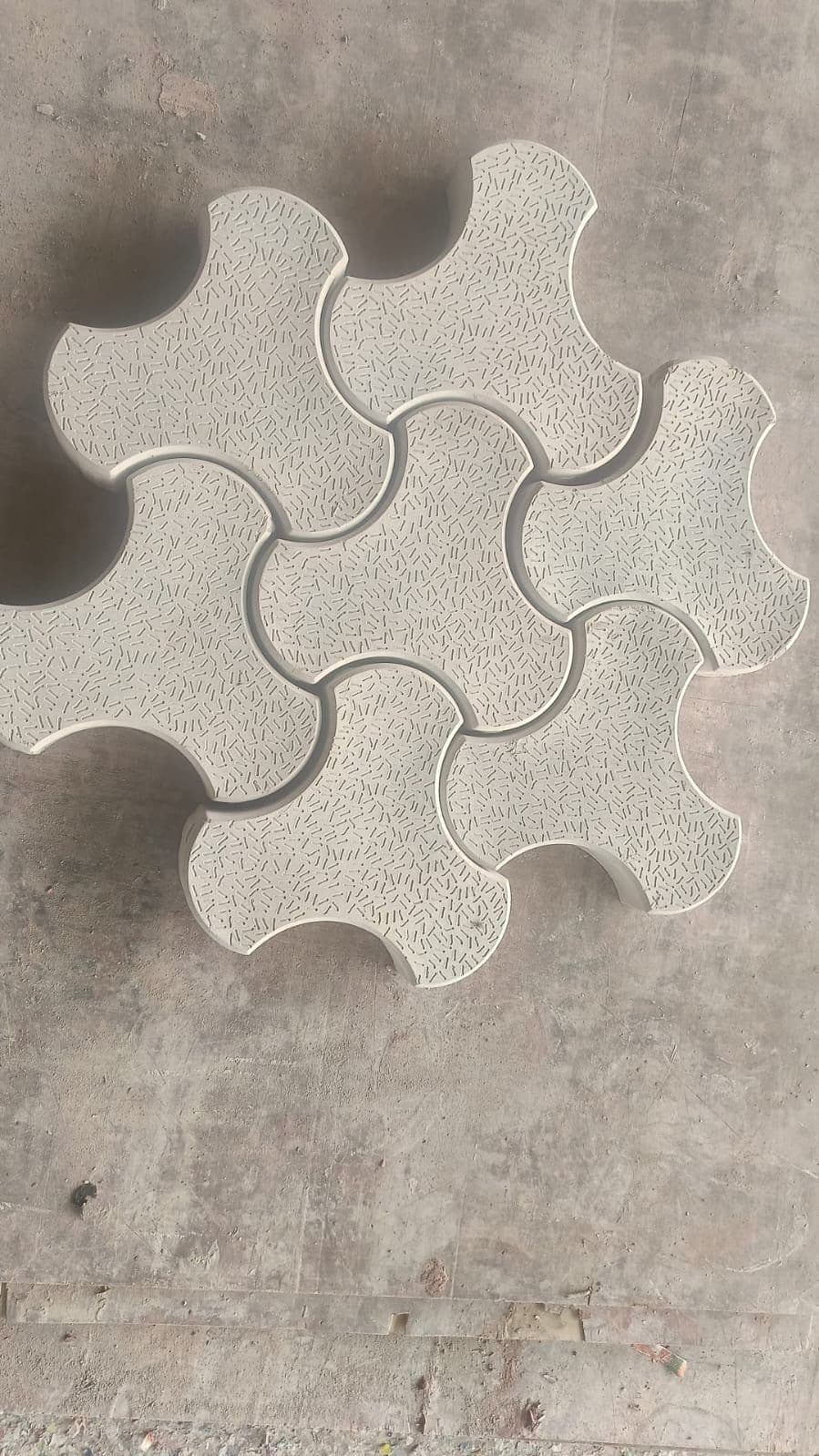
If you are planning paving work for parking, driveway, pathway, or outdoor flooring, one of the first questions is simple: how many paver blocks are required for 1000 sq ft?
The answer depends on the paver shape, actual coverage per piece, layout, cutting, wastage, and site measurement. Different paver designs cover different areas, so the quantity is not the same for every product.
Quick formula to estimate paver block quantity
For a quick estimate, use this formula:
Required pieces = Total area ÷ Coverage per piece
For 1000 sq ft:
Required pieces = 1000 ÷ coverage per piece
The final quantity should usually include extra pieces for cutting, edge finishing, breakage, and layout adjustment.
Why paver quantity changes by product
Paver block quantity changes because every design has a different size and coverage. A rectangle brick paver will require more pieces than a larger square paver because each piece covers less area.
The main factors are:
- Product shape and size
- Coverage per piece
- Thickness
- Joint spacing and laying pattern
- Cutting at edges
- Site measurement accuracy
- Wastage allowance
- Delivery and handling condition
Approximate paver quantity for 1000 sq. ft
Below are practical quantity estimates using the current AR Precast coverage data.
Rectangle Brick Paver 200 × 100 × 60 mm
- Approximate coverage: 0.2153 sq ft per piece
- Approximate quantity for 1000 sq ft: 4,645 pieces
- Best for: outdoor paving, pathways, and practical surface work
This design uses smaller pieces, so the piece count is higher than larger-format pavers.
Dumbbell Paver 200 × 160 × 60 mm
- Approximate coverage: 0.2942 sq ft per piece
- Approximate quantity for 1000 sq ft: 3,400 pieces
- Best for: parking, driveways, pathways, and general paving requirements
Dumbbell Paver 200 × 160 × 80 mm
- Approximate coverage: 0.2942 sq ft per piece
- Approximate quantity for 1000 sq ft: 3,400 pieces
- Best for: areas where heavier movement may be expected
The 80 mm option is generally discussed for heavier movement areas, but final selection should depend on actual site use, base preparation, and compaction.
Zig Zag Paver 250 × 120 × 60 mm
- Approximate coverage: 0.3229 sq ft per piece
- Approximate quantity for 1000 sq ft: 3,097 pieces
- Best for: interlocking layouts and outdoor paving work
Zig Zag Paver 250 × 120 × 80 mm
- Approximate coverage: 0.3229 sq ft per piece
- Approximate quantity for 1000 sq ft: 3,097 pieces
- Best for: heavier-use interlocking paving requirements
The piece count is similar to the 60 mm option because the top coverage is the same. Thickness affects use case, weight, handling, and pricing, not the top area coverage.
Milano Paver 225 × 260 × 60 mm
- Approximate coverage: 0.3992 sq ft per piece
- Approximate quantity for 1000 sq ft: 2,505 pieces
- Best for: decorative paving, outdoor areas, pathways, and selected parking applications
Milano pavers cover more area per piece than rectangle brick and dumbbell pavers, so the required number of pieces is lower.
Square Paver 200 × 200 × 60 mm
- Approximate coverage: 0.4306 sq ft per piece
- Approximate quantity for 1000 sq ft: 2,322 pieces
- Best for: simple paving layouts and practical surface work
Square Paver 100 × 100 × 60 mm
- Approximate coverage: 0.1076 sq ft per piece
- Approximate quantity for 1000 sq ft: 9,294 pieces
- Best for: smaller-format paving patterns and detailed layouts
Because this is a smaller paver, the required piece count is much higher.
Should you add wastage?
Yes. For most paving work, add a wastage allowance. A common planning range is 3 percent to 7 percent, depending on layout and cutting.
- For simple rectangular areas, wastage may be lower.
- For irregular areas, curved edges, manholes, tree pits, ramps, or multiple cutting points, wastage may be higher.
- For larger projects, confirm site measurement before final order quantity.
Example with 5 percent wastage
If calculated quantity is 3,400 pieces and you add 5 percent wastage:
Extra quantity = 3,400 × 5 percent = 170 pieces
Estimated order quantity = 3,570 pieces
This is still an estimate. Final quantity should be confirmed after actual site measurement.
Does thickness change the quantity?
Thickness usually does not change the number of pieces required for the same top size. A 60 mm and 80 mm paver with the same top coverage will cover the same area per piece.
Thickness affects:
- Product weight
- Handling
- Rate
- Use case suitability
- Loading and unloading
- Transport planning
- Site performance when combined with base preparation
For example, a 60 mm paver may be discussed for lighter use cases, while 80 mm may be discussed for heavier movement areas. Final selection depends on actual use, base preparation, compaction, and site condition.
Quick estimate list for 1000 sq ft
- Rectangle Brick Paver 200 × 100 × 60 mm: about 4,645 pieces
- Dumbbell Paver 200 × 160 × 60 mm: about 3,400 pieces
- Dumbbell Paver 200 × 160 × 80 mm: about 3,400 pieces
- Zig Zag Paver 250 × 120 × 60 mm: about 3,097 pieces
- Zig Zag Paver 250 × 120 × 80 mm: about 3,097 pieces
- Milano Paver 225 × 260 × 60 mm: about 2,505 pieces
- Square Paver 200 × 200 × 60 mm: about 2,322 pieces
- Square Paver 100 × 100 × 60 mm: about 9,294 pieces
What details should you share for a quote?
For faster quote discussion, share these details:
- Total area in sq ft or sq m
- Product design
- Thickness
- Colour
- Finish preference
- Delivery location
- Site use such as parking, driveway, pathway, or landscape
- Whether unloading support is needed
- Expected timeline
For Gurugram and Delhi NCR requirements, also share the exact delivery area because transport and unloading depend on location, quantity, vehicle access, and site condition.
Final note
These quantities are planning estimates. Final quantity and rate may vary based on actual site measurement, selected product, thickness, colour, finish, wastage, layout, cutting, loading, unloading, transport, and delivery location.
For a faster quote, call or WhatsApp AR Precast with your area, product preference, thickness, colour, and delivery location.